
Creative collaboration is changing the way teams think and work together. Organizations with strong collaborative cultures are 5 times more likely to see major performance improvements, according to Harvard research. Most people expect teamwork to just mean sharing tasks and checking off boxes. This flips the script because the most valuable teamwork happens when people break down barriers, share wild ideas, and build something no one could have imagined alone.
Defining Creative Collaboration: What Is It?
Creative collaboration represents a dynamic process where individuals from diverse backgrounds, skills, and perspectives unite to generate innovative solutions through collective thinking and mutual engagement. Unlike traditional teamwork, this approach transcends simple task completion and instead focuses on generating breakthrough ideas that emerge from genuine intellectual synergy.
The Core Essence of Creative Collaboration
At its foundation, creative collaboration is about breaking down traditional communication barriers and creating an environment where ideas can flow freely and spontaneously. Research from MIT’s Sloan Management Review reveals that successful creative collaboration depends on psychological safety, where team members feel comfortable sharing unconventional thoughts without fear of judgment.
The process involves several critical components:
- Mutual respect for different perspectives
- Openness to unexpected ideas
- Willingness to experiment and take intellectual risks
- Active listening and constructive dialogue
Distinguishing Creative Collaboration from Regular Teamwork
Traditional teamwork often follows predetermined paths and structured processes, whereas creative collaboration embraces unpredictability and emergent thinking. It requires participants to move beyond their individual expertise and engage in collective problem solving.
Stanford University’s Design School emphasizes that true creative collaboration involves developing a shared mental model where team members can build upon each other’s ideas, creating solutions more sophisticated than any individual could produce independently. This approach transforms group interactions from transactional exchanges into generative experiences that unlock collective potential.
To clarify the differences between creative collaboration and traditional teamwork, the following table summarizes their key characteristics and how they influence group outcomes.
| Aspect | Creative Collaboration | Traditional Teamwork |
|---|---|---|
| Approach | Dynamic, emergent, and collective idea generation | Structured, task-oriented, and process-driven |
| Communication | Open, fluid, encourages sharing unconventional ideas | Follows established channels, often hierarchical |
| Risk Tolerance | High, encourages experimentation and failure | Low, typically avoids uncertainty |
| Role of Diversity | Central, relies on varied backgrounds and perspectives | Less emphasized, may be homogeneous |
| Problem Solving | Collective, builds on each other’s ideas | Segmented, individual contributions to shared tasks |
| Outcomes | Innovative, often unexpected solutions | Predictable, fulfills planned objectives |
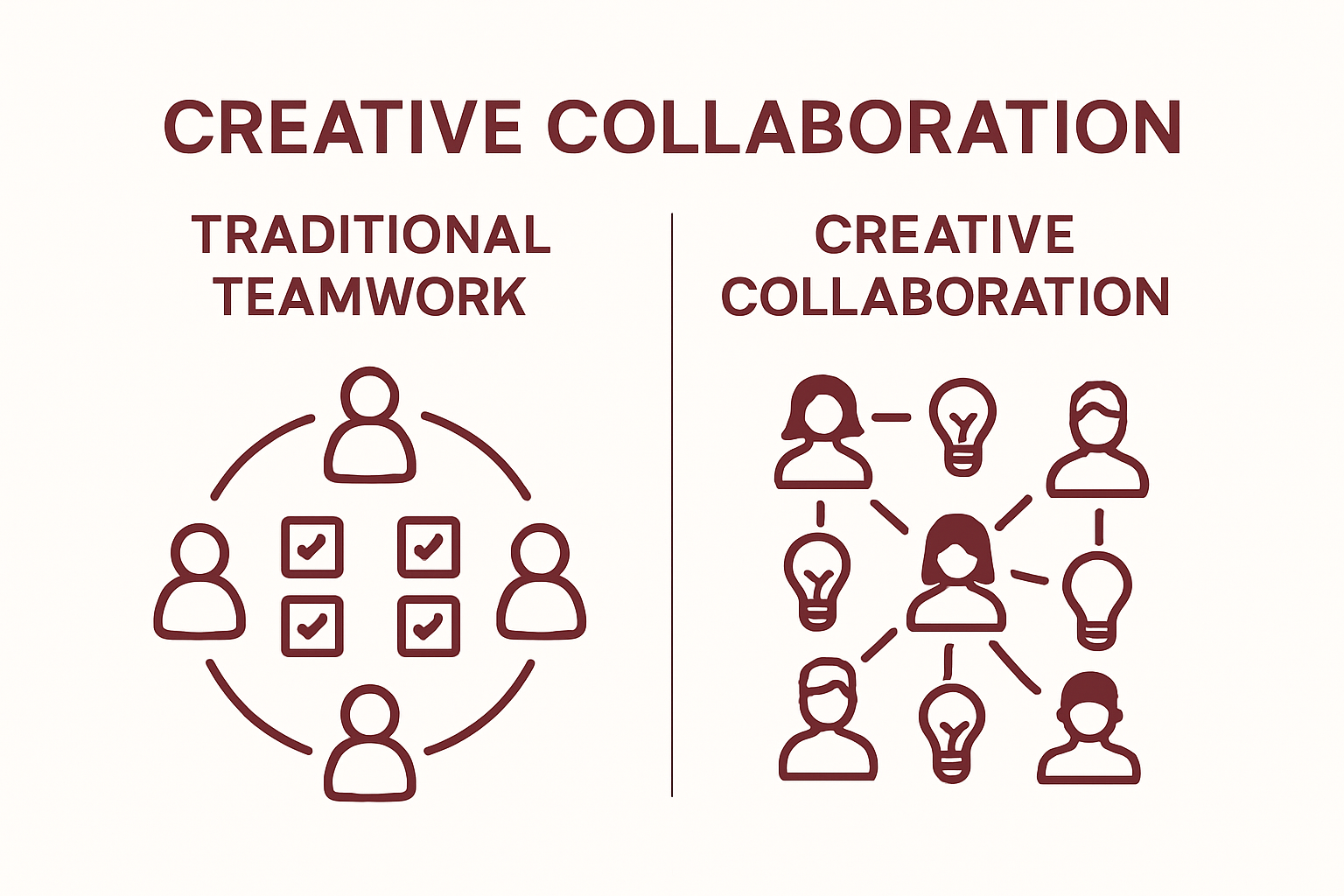
Understanding creative collaboration means recognizing it as more than a method but as a profound approach to human interaction and innovation. It represents a powerful paradigm where diversity of thought, mutual respect, and collaborative spirit converge to create extraordinary outcomes.
The Importance of Creative Collaboration in Teams
Creative collaboration transforms team dynamics from conventional working models into powerful innovation engines. By integrating diverse perspectives and collective intelligence, organizations can unlock extraordinary potential that transcends individual capabilities.
Driving Organizational Innovation
Teams that embrace creative collaboration become catalysts for breakthrough solutions. According to research from Harvard Business Review, organizations with strong collaborative cultures are 5 times more likely to experience significant performance improvements compared to traditional hierarchical structures.
The strategic benefits of creative collaboration include:
- Enhanced problem solving capabilities
- Accelerated knowledge sharing
- Increased employee engagement
- Reduced organizational silos
- Faster adaptation to complex challenges
Psychological and Performance Impacts
Creative collaboration goes beyond technical outcomes. Psychological safety emerges as a critical component, enabling team members to share unconventional ideas without fear of criticism. When individuals feel valued and heard, they become more committed and emotionally invested in collective goals.
Research from Google’s Project Aristotle demonstrated that teams with high psychological safety consistently outperform others. These teams generate more innovative solutions and maintain higher levels of interpersonal trust.
Ultimately, creative collaboration represents more than a methodology. It is a transformative approach that reimagines how human potential can be unlocked through genuine connection, mutual respect, and shared intellectual exploration. By creating environments where diverse talents intersect and collaborate authentically, organizations can develop unprecedented capacities for innovation and collective problem solving.

How Creative Collaboration Works: Key Concepts
Creative collaboration operates through intricate mechanisms that transform individual contributions into collective intelligence. Unlike traditional teamwork, this approach requires deliberate strategies and environments that nurture innovative thinking and mutual understanding.
Foundational Interaction Principles
Cognitive diversity serves as the primary engine of creative collaboration. Teams succeed when members bring unique perspectives, skills, and mental frameworks that complement one another. This diversity creates a rich intellectual ecosystem where ideas can cross-pollinate and evolve.
Research from MIT’s Collaborative Innovation Laboratory demonstrates that teams with varied backgrounds generate significantly more innovative solutions compared to homogeneous groups. The interaction model depends on several critical dynamics:
- Active listening and genuine curiosity
- Suspension of immediate judgment
- Willingness to integrate contradictory viewpoints
- Shared commitment to collective outcomes
Structural Elements of Collaborative Environments
Successful creative collaboration requires intentionally designed spaces that encourage open dialogue and intellectual risk taking. Psychological safety becomes paramount, enabling team members to propose unconventional ideas without fear of ridicule or professional repercussions.
Effective collaborative environments typically incorporate:
- Flexible communication channels
- Transparent decision making processes
- Mechanisms for constructive feedback
- Shared accountability for team outcomes
These structural elements transform creative collaboration from a theoretical concept into a practical approach for generating breakthrough innovations.
By establishing conditions that honor individual contributions while prioritizing collective intelligence, organizations can unlock unprecedented creative potential.
Real-World Applications of Creative Collaboration
Creative collaboration transcends theoretical concepts, manifesting in tangible applications across multiple industries and professional domains. Organizations increasingly recognize its potential to drive innovation, solve complex challenges, and generate transformative solutions.
Innovative Sectors Embracing Collaborative Approaches
Technology and software development represent prime examples of creative collaboration in action. Modern software engineering relies on cross-functional teams where designers, engineers, product managers, and user experience experts work synergistically to create breakthrough products.
Research from MIT Technology Review highlights several critical domains where creative collaboration generates extraordinary results:
- Healthcare technology development
- Complex scientific research projects
- Urban planning and sustainable design
- Emerging artificial intelligence solutions
- Interdisciplinary medical research
Transformative Organizational Implementations
Beyond specific sectors, creative collaboration fundamentally reshapes how organizations approach problem solving. Companies are redesigning traditional hierarchical structures to create more fluid, interconnected working environments that encourage knowledge sharing and collective intelligence.
Successful collaborative implementations typically involve:
- Establishing open communication platforms
- Creating cross-functional project teams
- Implementing flexible workspace designs
- Developing reward systems that recognize collaborative achievements
- Providing continuous learning and skill exchange opportunities
These strategic approaches enable organizations to tap into collective human potential, transforming creative collaboration from a theoretical concept into a powerful organizational strategy that drives sustainable innovation and competitive advantage.
Challenges and Solutions in Creative Collaboration
Creative collaboration, while powerful, is not without significant obstacles. Organizations must proactively address complex interpersonal and structural challenges to maintain the effectiveness of collaborative environments and ensure sustained innovative potential.
Identifying Common Collaborative Barriers
Communication complexity emerges as a primary challenge in creative collaboration. Teams frequently struggle with misaligned expectations, communication styles, and diverse professional backgrounds that can create friction and misunderstandings.
Research from Harvard Business Review identifies several critical barriers that impede effective collaboration:
- Ego-driven resistance to alternative perspectives
- Fear of vulnerability and potential criticism
- Lack of clear shared objectives
- Unequal power dynamics within teams
- Insufficient trust and psychological safety
Strategic Intervention Approaches
Successful creative collaboration requires deliberate strategies to overcome inherent challenges. Structured communication protocols and intentional team design can transform potential obstacles into opportunities for deeper understanding and innovation.
Effective intervention strategies include:
- Implementing regular feedback mechanisms
- Developing cross-cultural communication training
- Creating transparent decision making processes
- Establishing shared performance metrics
- Cultivating a culture of mutual respect and curiosity
These strategic approaches enable organizations to build resilient collaborative environments that can navigate complex interpersonal dynamics while maintaining focus on collective creative potential. By recognizing and proactively addressing collaboration challenges, teams can transform potential friction into a powerful catalyst for breakthrough innovations.
The following table presents common challenges teams face in creative collaboration, along with corresponding solutions found within the article for overcoming each barrier.
| Challenge | Description | Strategic Solution |
|---|---|---|
| Communication complexity | Misunderstandings due to diverse backgrounds | Cross-cultural training, regular feedback |
| Ego-driven resistance | Individuals resist alternative perspectives | Cultivate mutual respect and curiosity |
| Fear of vulnerability | Fear of criticism limits idea sharing | Foster psychological safety |
| Lack of clear shared objectives | Misaligned goals cause confusion | Establish shared performance metrics |
| Unequal power dynamics | Power imbalances hinder open dialogue | Transparent decision making processes |
| Insufficient trust | Low trust impedes constructive collaboration | Build trust through shared accountability |
Transform Your Team’s Creative Collaboration at The Nest
Struggling with endless meetings, office silos, and a lack of genuine collaboration? If your team is stuck in routine and missing out on true creative synergy, The Nest offers a powerful way to break free. Our approach directly aligns with the article’s focus on psychological safety, collective problem solving, and creating environments where breakthrough ideas thrive.
With thoughtfully designed retreats, hands-on workshops, and immersive group experiences, The Nest is where teams reconnect and rediscover their creative potential. Now is the time to foster the kind of creative collaboration that drives real change. Learn more and start planning your team’s next breakthrough experience at sharethenest.com.
Frequently Asked Questions
What is creative collaboration?
Creative collaboration is a dynamic process where individuals with diverse backgrounds and skills unite to generate innovative solutions through collective thinking and mutual engagement, focusing on intellectual synergy rather than simple task completion.
How does creative collaboration differ from traditional teamwork?
Unlike traditional teamwork, which often follows structured processes, creative collaboration embraces unpredictability and emergent thinking, allowing team members to engage in collective problem solving and build upon each other’s ideas.
What are the benefits of creative collaboration in organizations?
Creative collaboration drives organizational innovation by enhancing problem-solving capabilities, accelerating knowledge sharing, increasing employee engagement, reducing silos, and improving adaptability to complex challenges.
What are the key components necessary for effective creative collaboration?
Effective creative collaboration requires mutual respect for diverse perspectives, openness to unexpected ideas, willingness to take risks, active listening, and an environment of psychological safety where individuals feel comfortable sharing their thoughts.