
Collaboration is transforming how teams tackle complex problems and push the boundaries of innovation. It is not just group work. Teams that collaborate well are 1.5 times more likely to generate innovative solutions, according to MIT Sloan research. Most people think collaboration is simply about sharing the load, but the real secret is the burst of creativity and trust that happens when diverse minds unite. The results go far beyond what anyone could do alone.
The Concept of Collaboration and Its Importance
Collaboration represents a fundamental strategy where individuals combine their skills, perspectives, and efforts to achieve shared objectives. More than a simple teamwork approach, collaboration transforms how organizations solve complex challenges and drive innovation.
Understanding Collaborative Dynamics
At its core, collaboration goes beyond basic cooperation. It involves active engagement, mutual respect, and a collective commitment to achieving results that transcend individual capabilities. Research from MIT Sloan Management Review suggests that successful collaboration requires deep interpersonal connections and a culture of trust.
Key characteristics of effective collaboration include:
The table below organizes the key characteristics of effective collaboration mentioned in the article for quick reference and comparison.
| Characteristic | Description |
| Open communication channels | Team members share information freely and transparently |
| Shared accountability | Responsibility for outcomes is distributed among all participants |
| Complementary skill sets | Diverse abilities and expertise are combined for stronger results |
| Mutual understanding and respect | Team members value different perspectives and respect each other’s contributions |
| Willingness to compromise | Participants are flexible and open to finding shared solutions |
-
Open communication channels
-
Shared accountability
-
Complementary skill sets
-
Mutual understanding and respect
-
Willingness to compromise
Why Collaboration Drives Team Success
Collaboration fundamentally transforms team performance by creating synergistic environments where collective intelligence emerges. When team members combine their unique perspectives and expertise, they generate solutions far more sophisticated than individual contributions.
Stanford University research demonstrates that collaborative teams demonstrate higher levels of engagement, creativity, and problem-solving capabilities. By breaking down organizational silos and encouraging cross-functional interactions, teams can unlock unprecedented levels of innovation and efficiency.
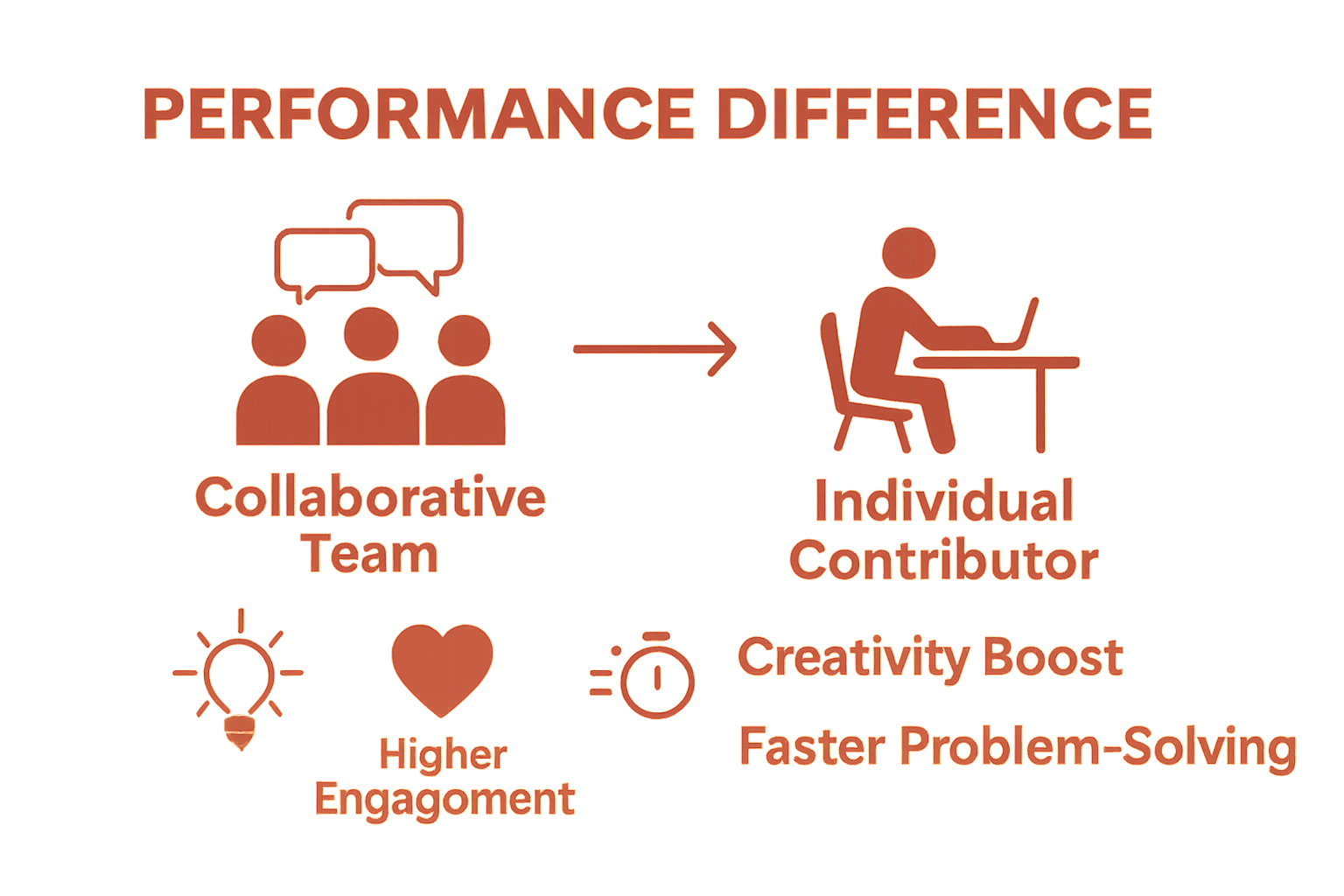
The most successful collaborative environments recognize that diversity of thought and experience is not a challenge to overcome, but a powerful resource to leverage.
Teams that embrace collaborative principles can adapt more quickly, respond more effectively to complex challenges, and generate breakthrough solutions that drive organizational success.
How Collaboration Enhances Problem Solving and Innovation
Collaboration acts as a powerful catalyst for transforming complex problem-solving and driving organizational innovation. By integrating diverse perspectives and collective intelligence, teams can generate breakthrough solutions that transcend individual thinking limitations.
The Cognitive Diversity Advantage
Cognitive diversity represents a critical mechanism through which collaboration amplifies problem-solving capabilities. When team members with different backgrounds, expertise, and thinking styles converge, they create a rich intellectual ecosystem that challenges assumptions and generates more robust solutions.
Research from Harvard Business Review highlights that teams with cognitive diversity solve problems faster and more effectively compared to homogeneous groups. Key advantages include:
-
Broader perspective exploration
-
Reduced blind spots in strategic thinking
-
Enhanced critical analysis of potential solutions
-
Increased adaptability to complex challenges
Collaborative Innovation Frameworks
Successful collaborative innovation requires structured approaches that encourage creative thinking and systematic problem resolution. Teams that implement deliberate collaborative frameworks can systematically convert collective insights into actionable strategies.
Cross-functional collaboration emerges as a particularly powerful mechanism for driving innovation. By bringing together professionals from different departments and disciplines, organizations create environments where breakthrough ideas can naturally emerge. Research from MIT Sloan demonstrates that organizations with strong cross-functional collaboration are 1.5 times more likely to generate innovative solutions.
Ultimately, collaboration transforms problem-solving from an individual endeavor into a collective intelligence process. By embracing diverse perspectives, maintaining open communication, and creating psychological safety, teams can unlock unprecedented levels of creative potential and organizational innovation.
The Impact of Collaboration on Team Dynamics and Trust
Collaboration fundamentally reshapes team interactions, creating intricate networks of communication, shared understanding, and mutual accountability. More than a simple working arrangement, collaborative environments cultivate deep interpersonal connections that transform how teams function and achieve their objectives.
Building Psychological Safety
Psychological safety emerges as a critical component in collaborative team dynamics. When team members feel secure expressing ideas, sharing vulnerabilities, and taking intellectual risks without fear of ridicule or professional repercussions, trust flourishes. Research from Google’s Project Aristotle revealed that psychological safety is the most significant predictor of team performance.
Key elements that contribute to psychological safety include:
-
Encouraging open and respectful communication
-
Valuing diverse perspectives
-
Creating non-punitive environments for learning
-
Demonstrating genuine curiosity about team members’ insights
-
Normalizing vulnerability and admitting mistakes
Trust as a Collaborative Catalyst
Trust acts as the fundamental adhesive that binds collaborative efforts. It transforms individual contributions into cohesive, high-performing team experiences. When team members trust one another, they communicate more openly, take calculated risks, and invest deeper emotional and intellectual energy into shared goals.
Interpersonal trust develops through consistent behaviors that demonstrate reliability, competence, and genuine care. Teams that prioritize transparent communication, follow through on commitments, and show genuine respect for each member’s contributions create robust trust ecosystems.
Ultimately, collaboration is not just about working together, but about creating human connections that transcend traditional workplace interactions. By nurturing trust, encouraging psychological safety, and valuing each team member’s unique contributions, organizations can build resilient, innovative, and deeply connected teams.
Real-World Examples of Successful Collaboration Benefits
Collaboration transcends theoretical concepts, delivering tangible results across various industries and organizational contexts. By examining concrete examples, we can understand how strategic collaborative approaches translate into measurable performance improvements and innovative breakthroughs.
Healthcare Collaboration Transformations
Healthcare represents a powerful domain where collaborative approaches dramatically improve patient outcomes and organizational effectiveness. Research from Johns Hopkins University demonstrates how interdisciplinary teams can revolutionize medical care delivery.
Successful healthcare collaboration strategies include:
-
Integrated care teams with shared patient management
-
Cross-disciplinary knowledge exchange
-
Real-time communication protocols
-
Comprehensive patient-centered approaches
-
Continuous learning and skill development
Technology and Innovation Ecosystems
Technology companies exemplify how collaboration drives breakthrough innovations. Organizations like Google and Apple have consistently demonstrated that cross-functional teams can generate revolutionary products by breaking traditional departmental boundaries.
Complex problem-solving emerges when engineers, designers, researchers, and marketing professionals collaborate seamlessly. By creating environments that encourage open communication and intellectual exchange, these organizations transform collaborative potential into market-defining innovations.
Ultimately, successful collaboration is not about mandating teamwork, but creating environments where diverse talents can naturally converge, challenge existing paradigms, and generate solutions that no single individual could achieve alone. The most progressive organizations recognize collaboration as a strategic advantage, not just a operational necessity.
Strategies to Foster Collaboration in Remote Teams
Remote collaboration demands intentional strategies that bridge physical distances and create meaningful connections. As organizations increasingly embrace distributed work models, developing robust collaborative frameworks becomes essential for maintaining team cohesion, productivity, and engagement.
Communication Infrastructure and Tools
Building a strong digital communication infrastructure forms the foundation of successful remote collaboration. Effective teams leverage technologies that facilitate seamless information exchange, real-time interactions, and transparent workflows.
McKinsey research highlights the importance of creating digital environments that replicate organic workplace interactions. Key technological considerations include:
-
Integrated communication platforms
-
Project management tools with transparent tracking
-
Virtual whiteboarding capabilities
-
Secure file sharing systems
-
Video conferencing with collaborative features
Cultivating Virtual Team Culture
Successful remote collaboration transcends technological solutions. Organizational culture plays a critical role in maintaining team connections and motivation. Teams must intentionally design experiences that foster trust, social connection, and shared purpose despite physical separation.
Strategies for building virtual team culture include creating dedicated spaces for non-work interactions, establishing clear communication norms, and developing rituals that reinforce team identity. Regular virtual social events, spontaneous video chat opportunities, and structured check-ins help replicate the subtle interpersonal dynamics of in-person work environments.
This table summarizes strategies and tools for fostering collaboration in remote teams, highlighting infrastructure and cultural approaches presented in the article.
| Strategy/Tool | Purpose/Benefit |
| Integrated communication platforms | Enable seamless real-time and asynchronous team discussions |
| Project management tools | Provide transparent tracking and accountability |
| Virtual whiteboarding capabilities | Support interactive brainstorming and visual collaboration |
| Secure file sharing systems | Allow safe exchange and management of team documents |
| Video conferencing with collaborative features | Promote face-to-face interaction and live problem-solving |
| Virtual team culture rituals | Strengthen team identity and foster informal connections |
| Non-work interaction spaces | Facilitate social bonding and sustain engagement |
Ultimately, remote collaboration requires a holistic approach that balances technological infrastructure, intentional communication strategies, and human-centered design principles. Organizations that view remote collaboration as an opportunity for reimagining teamwork, rather than a compromise, will unlock unprecedented levels of flexibility and performance.

Break Free From Team Silos and Create Real Momentum
Give your team more than just theory. At The Nest, your group can step outside routine and experience what genuine collaboration feels like. Our immersive workshops and thoughtfully designed spaces are made for teams who want to reset, recharge, and actually work better together. Escape the patterns that hold your team back and take action now at https://sharethenest.com. The most meaningful change happens when you shift your team’s environment, don’t wait to spark your next breakthrough.
Frequently Asked Questions
What are the key characteristics of effective collaboration?
Effective collaboration includes open communication channels, shared accountability, complementary skill sets, mutual understanding and respect, and a willingness to compromise.
How does collaboration enhance problem-solving capabilities?
Collaboration enhances problem-solving by integrating diverse perspectives and creating cognitive diversity, which helps teams generate more robust solutions and reduces blind spots in strategic thinking.
Why is psychological safety important in collaborative teams?
Psychological safety fosters an environment where team members feel secure to express ideas and take intellectual risks without fear of ridicule, which is critical for building trust and enhancing team performance.
What strategies can organizations use to foster collaboration in remote teams?
Organizations can foster remote collaboration by building strong digital communication infrastructures, utilizing project management tools, and cultivating a virtual team culture that includes non-work interactions and clear communication norms.
Recommended
-
Fostering Team Collaboration for Powerful Results With Adobe Solutions –