
Collaborative brainstorming is reshaping the way companies generate ideas and solve problems. Most people think it is just about tossing ideas around a table. But studies show that teams who use structured brainstorming methods can generate up to 30 percent more actionable solutions than those who stick to old-school approaches. So while you might expect another chaotic meeting, the real surprise is that collaborative brainstorming can unlock creativity and innovation you did not even know your team had.
Defining Collaborative Brainstorming in the Corporate Context
Collaborative brainstorming represents a dynamic problem-solving approach where team members collectively generate, explore, and refine innovative ideas within an organizational setting. Unlike traditional brainstorming methods that often rely on individual contributions, this approach transforms idea generation into a collaborative, interactive process that leverages collective intelligence.
The Core Philosophy of Collaborative Brainstorming
At its foundation, collaborative brainstorming recognizes that complex business challenges cannot be solved by a single perspective. Research from MindTools demonstrates that when diverse team members engage in structured ideation, the potential for breakthrough solutions dramatically increases. The approach relies on several key principles
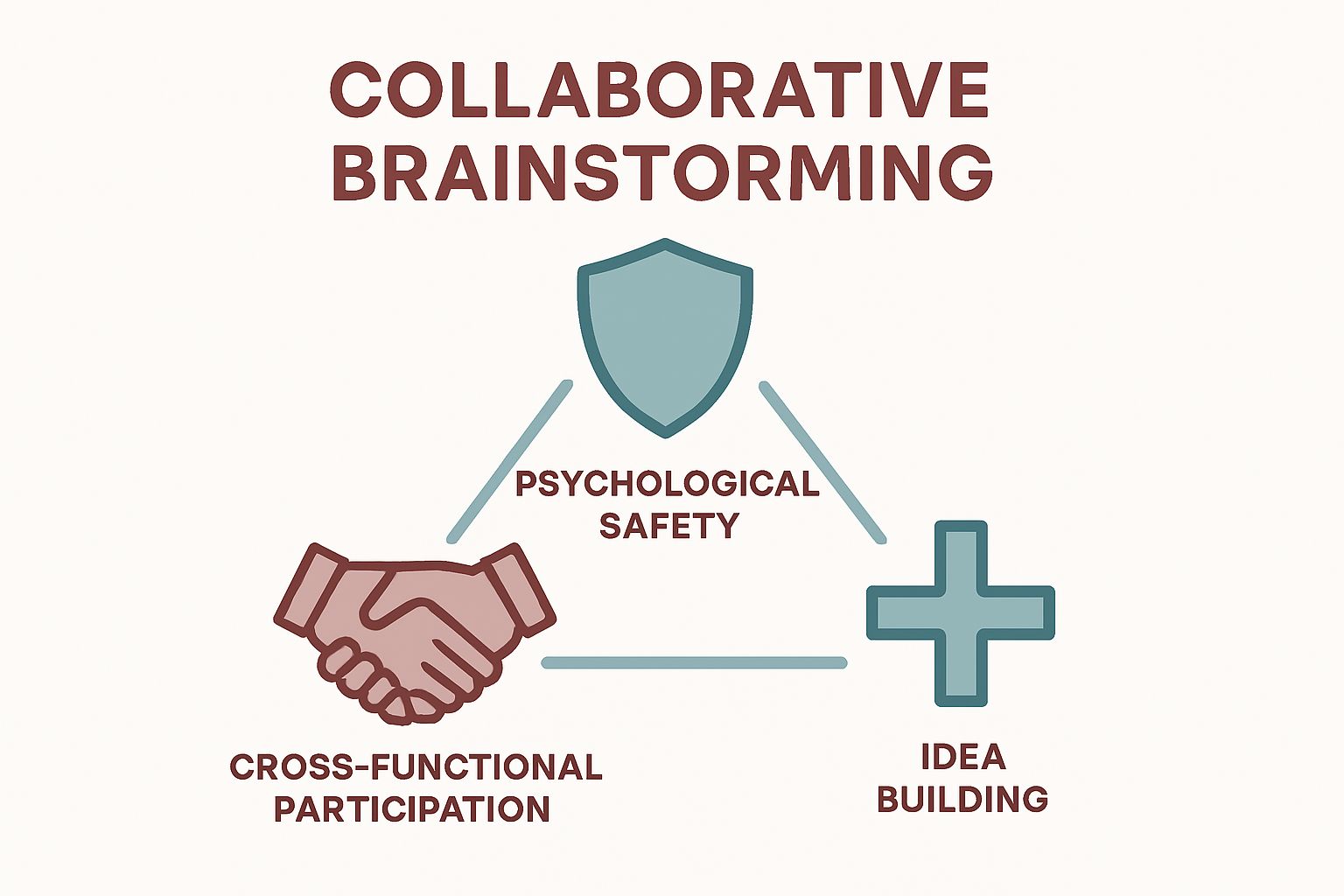 :
-
Creating a psychologically safe environment where all ideas are initially welcomed
-
Encouraging cross-functional participation and perspectives
-
Building upon each other’s concepts rather than critiquing them immediately
Transforming Organizational Thinking
Traditional corporate environments often suppress creativity through hierarchical structures and fear of criticism. Collaborative brainstorming disrupts these patterns by establishing a framework where innovation emerges through collective exploration. This method moves beyond linear thinking, allowing teams to uncover solutions that no single individual might have conceived independently.
By treating idea generation as a cooperative endeavor, organizations can unlock unprecedented levels of creativity.
To clarify the significant differences between traditional and collaborative brainstorming, the following table compares core characteristics mentioned in the article.
| Aspect | Traditional Brainstorming | Collaborative Brainstorming |
| Approach | Individual contributions dominate | Interactive group process leverages team input |
| Creativity Driver | Often linear, less dynamic | Non-linear, encourages new perspectives |
| Hierarchy/Power Dynamics | Can reinforce silos and hierarchy | Democratizes idea generation across roles |
| Psychological Safety | Risk of fear or criticism limits openness | Establishes psychologically safe environment |
| Outcome | May lead to fewer actionable solutions | Yields higher quantity and quality of ideas |
| Participation | Sometimes unbalanced or passive | Ensures active, inclusive participation |
| Long-term Benefits | Limited team growth and innovation | Builds trust, synergy, and shared ownership |
| The process transforms brainstorming from a mechanical exercise into a dynamic, engaging interaction where team members feel genuinely heard and valued. Each participant becomes both a contributor and a catalyst, creating a powerful synergy that drives meaningful organizational innovation. |
The Importance of Collaborative Brainstorming for Teams
Collaborative brainstorming transcends traditional problem-solving methods by creating a powerful ecosystem of collective intelligence, where team dynamics transform from competitive to synergistic. This approach is not merely about generating ideas but about building a robust intellectual environment that nurtures innovation and shared understanding.
Unlocking Team Potential Through Collective Intelligence
Research from the National Institutes of Health reveals that collaborative brainstorming significantly enhances team performance by leveraging diverse perspectives and collective knowledge. The process fundamentally shifts how teams approach challenges, moving from isolated thinking to interconnected problem-solving. Key benefits include:
-
Breaking down organizational silos
-
Democratizing idea generation across hierarchical levels
-
Creating a sense of shared ownership in solutions
Psychological and Performance Advantages
Beyond mere idea generation, collaborative brainstorming produces profound psychological benefits for team members. Psychological safety emerges as a critical outcome, where team members feel empowered to contribute without fear of ridicule or professional repercussions. This environment cultivates trust, encourages vulnerability, and enables individuals to bring their most creative and authentic selves to work.
Moreover, the collaborative approach transforms team interactions from transactional to transformational. By valuing each member’s contribution, organizations create a culture of mutual respect and continuous learning. Teams become more resilient, adaptable, and capable of navigating complex challenges with creativity and shared commitment.

Key Principles and Techniques Behind Effective Brainstorming
Effective collaborative brainstorming is a sophisticated process that requires intentional design, strategic facilitation, and a deep understanding of group dynamics. Far from being a random exchange of ideas, it demands structured approaches that systematically unlock team creativity and potential.
Creating the Right Collaborative Environment
Research from Harvard Business Review highlights the critical importance of psychological and physical environments in successful brainstorming. The most effective collaborative sessions are characterized by specific foundational principles:
-
Establishing explicit ground rules that protect all contributions
-
Designing physical or virtual spaces that encourage open communication
-
Ensuring participants feel equally valued and empowered
Structured Ideation Techniques
Brainstorming techniques move far beyond simply gathering people in a room. Systematic methods transform random thoughts into strategic insights. These approaches include:
-
Reverse brainstorming, where teams approach problems by considering opposite scenarios
-
Mind mapping to visually connect and explore related concepts
-
Round-robin techniques ensuring every participant contributes
Successful collaborative brainstorming requires facilitators who understand group psychology and can navigate complex interpersonal dynamics. The goal is not merely generating ideas but creating an ecosystem where creativity flourishes, diverse perspectives intersect, and innovative solutions emerge organically. By implementing these principles, teams can transform brainstorming from a routine meeting into a powerful catalyst for organizational innovation.
The table below summarizes key principles and structured techniques that make collaborative brainstorming effective, based on the practices described in the article.
| Principle/Technique | Description |
| Psychological Safety | Creating a space where all ideas are welcomed without judgment |
| Cross-Functional Participation | Involving members from different roles and departments |
| Ground Rules | Establishing explicit norms to protect and value all contributions |
| Mind Mapping | Visual technique to connect and explore related concepts |
| Reverse Brainstorming | Tackling the problem by considering opposite scenarios |
| Round-Robin | Ensuring everyone participates by contributing in turn |
| Rotating Facilitation | Sharing leadership responsibilities among team members |
Real-World Applications of Collaborative Brainstorming
Collaborative brainstorming extends far beyond theoretical concepts, becoming a transformative approach across diverse industries and organizational contexts. By harnessing collective intelligence, teams can solve complex challenges, drive innovation, and create breakthrough solutions that individual thinking cannot achieve.
Cross-Functional Problem Solving
Research in Healthcare Settings demonstrates how collaborative brainstorming enables multidisciplinary teams to develop sophisticated solutions. Organizations increasingly recognize that complex problems require integrated perspectives. This approach proves particularly powerful in fields requiring nuanced, holistic understanding:
-
Technology companies designing next-generation products
-
Healthcare teams developing patient care protocols
-
Engineering groups solving complex systems challenges
Strategic Innovation and Organizational Transformation
Beyond immediate problem-solving, collaborative brainstorming serves as a strategic tool for organizational evolution. Companies leverage these techniques to:
-
Reimagine business models
-
Identify emerging market opportunities
-
Challenge existing operational assumptions
The most successful organizations view collaborative brainstorming not as an isolated activity but as an ongoing cultural practice. By creating spaces where diverse perspectives converge, companies can unlock unprecedented levels of creativity and adaptability. These sessions become more than meetings, they transform into catalysts for continuous organizational learning and innovation.
Overcoming Challenges in Collaborative Brainstorming Sessions
Collaborative brainstorming, while powerful, is not without its inherent complexities. Organizations must proactively address potential barriers that can undermine the effectiveness of collective ideation, transforming potential obstacles into opportunities for deeper engagement and more robust solution development.
Understanding Interpersonal Dynamics
Research from the American Psychological Association reveals critical insights into group interaction challenges. Psychological barriers frequently emerge that can derail collaborative efforts, including:
-
Hierarchical intimidation preventing junior members from sharing ideas
-
Personality conflicts that create unproductive tension
-
Unequal participation where dominant personalities overshadow quieter team members
Strategic Mitigation Techniques
Successful collaborative brainstorming requires intentional design and facilitation to neutralize potential roadblocks. Organizations can implement several strategic approaches:
-
Establishing clear ground rules that protect all contributions
-
Using anonymous or digital submission methods to level power dynamics
-
Rotating facilitation responsibilities to distribute leadership
The most effective teams view challenges not as insurmountable barriers but as opportunities for growth and deeper understanding. By creating structured environments that prioritize psychological safety, respect, and inclusive participation, organizations can transform potential friction points into catalysts for more meaningful and innovative collaborative experiences.
Transform Teamwork with The Nest: Bring Collaborative Brainstorming to Life
Are you finding it hard to break through routine office silos and move beyond uninspired meetings? The article on collaborative brainstorming makes it clear that real innovation requires more than just traditional team discussions. Too often, organizations struggle with disengaged participants and lack the right environment for genuine ideation. If you want to switch from rigid structures to spaces that spark psychological safety, trust, and true creativity, your team deserves an environment built for deep connection and bold ideas.
Frequently Asked Questions
What is collaborative brainstorming?
Collaborative brainstorming is a team-based approach to generating and refining ideas collectively, rather than relying on individual contributions. To implement this in your organization, encourage team members to share thoughts openly in a supportive environment where every idea is valued.
How can I create a psychologically safe environment for brainstorming?
To create a psychologically safe environment, establish explicit ground rules that encourage participation without fear of criticism. Begin your sessions by agreeing that all contributions are welcome and emphasize the importance of respect.
What techniques can I use to facilitate effective collaborative brainstorming?
Use techniques such as mind mapping or round-robin brainstorming to ensure everyone contributes. Try incorporating at least three different methods in your next session to promote varied perspectives and engagement.
How do I overcome challenges in collaborative brainstorming sessions?
Address challenges by fostering open dialogue about interpersonal dynamics and implementing strategies like anonymous idea submission. This can help reduce intimidation and encourage quieter members to participate actively, thereby improving overall session effectiveness.
How can I ensure equal participation in collaborative brainstorming?
To ensure equal participation, rotate facilitation roles among team members and set clear expectations about contribution from everyone. Facilitate a session where each member is given a time slot to share their ideas, which can increase engagement and creativity.
What are the long-term benefits of adopting collaborative brainstorming in my team?
Adopting collaborative brainstorming can enhance creativity, break down silos, and create a culture of shared ownership in solutions. Aim to implement this practice regularly, measuring improvements in team dynamics and innovation over the next few months.