
Teams face endless setbacks when rushing into problem solving without a clear target. Projects get bogged down, meetings drag on, and results often miss the mark. Yet teams that invest time in precisely defining the problem are 45 percent more likely to land on an effective solution. Most expect brainstorming and raw talent to carry the day, but the real secret starts before anyone throws out their first idea. The most impactful solutions actually come from stopping to sharpen your aim before the first step is taken.
Step 1: Define the Problem Clearly
Clear problem definition is the foundation of effective team problem solving. Without a precise understanding of the challenge, teams risk wasting time, energy, and resources on misguided efforts. Successful problem definition transforms vague challenges into actionable objectives that unite team members toward a common goal.
Begin by creating a comprehensive problem statement that captures the core issue in specific, measurable terms. This means moving beyond surface level observations and digging deeper into the root causes and actual implications of the challenge. Ask critical questions that help deconstruct the problem: What exactly is happening? When does it occur? Who is impacted? What evidence exists that demonstrates this is a genuine problem requiring resolution?
Research from Stanford University indicates that teams who invest time in meticulously defining their problem are 45% more likely to develop effective solutions. The process requires collective input and honest dialogue. Invite team members to share their perspectives, ensuring multiple viewpoints are considered. This collaborative approach not only provides a more comprehensive understanding but also builds initial team commitment to the problem solving process.
To verify your problem definition is robust, check whether it meets three key criteria. First, the problem statement should be clear enough that any team member could explain it to an outside party. Second, it must articulate the gap between current performance and desired outcomes. Third, the statement should avoid suggesting specific solutions, focusing instead on describing the challenge objectively.
Consider using structured frameworks like the 5 Whys technique to drill down into the fundamental nature of the problem. This method involves repeatedly asking “why” to uncover deeper systemic issues rather than treating superficial symptoms. By embracing this methodical approach, teams transform ambiguous challenges into precise, manageable objectives that set the stage for collaborative problem resolution.
Step 2: Assemble the Right Team Members
Creating an effective problem solving team requires strategic selection that goes beyond simply grabbing the nearest colleagues. The right team composition can dramatically increase your chances of developing innovative and comprehensive solutions. Think of team assembly as crafting a human puzzle where each member brings unique skills, perspectives, and capabilities that collectively create a more powerful problem solving unit.
Start by identifying individuals with diverse skill sets and complementary strengths. This means looking beyond traditional hierarchical structures and recognizing that the most junior team member might hold critical insights or technical knowledge essential to solving the challenge. Seek out team members who demonstrate not just technical expertise, but also strong collaborative skills, emotional intelligence, and a genuine commitment to finding solutions.
Research from MIT Sloan Management Review suggests that teams with cognitive diversity solve complex problems faster and more effectively than homogeneous groups. Consider recruiting team members from different departments, backgrounds, and levels of experience. An engineer might see a problem differently from a marketing specialist, and a recent graduate could bring fresh perspectives that seasoned professionals might overlook.
Evaluate potential team members based on several key attributes. Look for individuals who demonstrate curiosity, adaptability, and a willingness to challenge existing assumptions. Communication skills are paramount – select team members who can articulate their thoughts clearly, listen actively, and engage constructively with different viewpoints. Equally important is ensuring team members have sufficient bandwidth to contribute meaningfully, avoiding overloaded schedules that might prevent full engagement.
To verify you have assembled the right team, conduct an initial assessment meeting. Observe how team members interact, share ideas, and respond to initial problem exploration. A strong team will demonstrate mutual respect, collaborative energy, and a shared commitment to understanding and resolving the challenge at hand. If the initial interactions feel forced or unproductive, be prepared to make adjustments to your team composition.
Step 3: Gather and Analyze Relevant Data
Data gathering and analysis form the critical bridge between problem identification and solution development. Transforming vague challenges into concrete opportunities requires a systematic approach to collecting and interpreting information. This step is about building a comprehensive understanding that moves beyond assumptions and emotional responses.
Begin by creating a strategic data collection plan that identifies multiple sources of information. Internal resources like company reports, performance metrics, and team feedback provide valuable baseline insights. External sources such as industry benchmarks, market research, and expert perspectives can offer broader context. Encourage team members to bring diverse data sources, ensuring a multifaceted view of the problem.
Research from the National Institutes of Health demonstrates that data-driven decision making significantly improves problem solving accuracy. When collecting data, prioritize quality over quantity. Focus on gathering information that directly relates to the problem statement developed in the first step. Use a mix of quantitative metrics and qualitative insights to create a holistic understanding.
Analyzing the collected data requires a structured and objective approach. Create visual representations like charts, graphs, or mind maps to help the team identify patterns, trends, and potential root causes. Look for connections that might not be immediately apparent. Encourage team members to challenge initial interpretations and explore alternative explanations. The goal is to develop a nuanced understanding that reveals the true complexity of the problem.
To verify the effectiveness of your data gathering and analysis, assess whether the team can now articulate the problem with greater precision. Can you clearly explain the key factors contributing to the challenge? Have you uncovered unexpected insights that reframe the original problem statement? A successful data analysis phase will provide a solid foundation for generating potential solutions, transforming abstract challenges into manageable, well-understood opportunities for innovative problem solving.
Step 4: Brainstorm Possible Solutions Together
Brainstorming transforms analytical insights into potential pathways forward. This is the creative engine of problem solving where imagination meets structured thinking. The goal is to generate a wide range of potential solutions without immediate judgment or criticism, creating a safe space for innovative thinking.
Establish clear ground rules that encourage open and fearless idea sharing. Create an environment where no suggestion is too unconventional and every team member feels empowered to contribute. Begin with a warm up exercise that breaks down psychological barriers and gets team members comfortable with collaborative ideation. This might involve a quick creative challenge or a brief discussion that encourages lateral thinking.
Research from the National Institutes of Health highlights that inclusive brainstorming approaches significantly enhance solution generation. Use techniques that promote diverse thinking, such as reverse brainstorming, where team members explore the opposite of solving the problem, or mind mapping to visually connect related ideas. Encourage wild, seemingly impossible suggestions alongside practical approaches, as breakthrough solutions often emerge from unexpected connections.
Implement a structured approach to capturing ideas. Use digital collaboration tools that allow real time input and visual organization. Consider techniques like the six thinking hats method, where team members deliberately explore solutions from different perspectives – emotional, logical, creative, cautious, optimistic, and procedural. This approach ensures comprehensive solution exploration and prevents dominant personalities from overshadowing quieter team members.
To verify the effectiveness of your brainstorming session, assess the quality and diversity of generated solutions. A successful brainstorming outcome will include a mix of incremental improvements and potentially transformative approaches. Look for solutions that not only address the immediate problem but also create opportunities for long term improvement. The final collection of ideas should feel energizing, representing a collective vision of potential paths forward.

Step 5: Evaluate and Select the Best Solution
Evaluating and selecting the optimal solution transforms a collection of ideas into a strategic path forward. This critical step requires a disciplined approach that balances creativity with pragmatic assessment. The goal is to move from multiple possibilities to a single, well reasoned solution that addresses the core problem effectively.
Develop a comprehensive evaluation framework that considers multiple dimensions of each potential solution. Create a scoring system that weights different criteria such as feasibility, cost effectiveness, potential impact, implementation time, and alignment with organizational goals. This structured approach prevents decision making from becoming a popularity contest or being dominated by the most vocal team members.
Research from Mind Tools demonstrates that systematic evaluation significantly improves solution selection. Conduct a thorough analysis by asking critical questions about each proposed solution. What are the potential risks? What resources would be required? How does this solution address the root causes identified in earlier data analysis? Encourage team members to play devils advocate, identifying potential weaknesses and challenges in each approach.
Consider using decision making tools like a weighted decision matrix or cost benefit analysis to objectively compare solutions. These techniques provide a visual and quantitative method for assessing different options. Involve the entire team in the evaluation process, but be prepared to make final decisions based on objective criteria. Transparency is key – ensure that everyone understands how the final solution was selected.
To verify the effectiveness of your solution selection, conduct a final team review that addresses three critical questions. First, does this solution comprehensively address the original problem statement? Second, do team members feel confident in the chosen approach? Third, can the solution be implemented with the available resources and skills? A successful evaluation process will result in a solution that feels both innovative and achievable, with clear support from the entire team.
The table below provides a checklist to help teams verify the effectiveness of each step in the problem solving process, making sure nothing important is missed along the way.
| Step | Verification Criteria |
|---|---|
| Define the Problem | Can any team member clearly explain the problem to others? Does the statement define the gap between current and desired outcomes? No solutions suggested yet? |
| Assemble Team | Does the team represent diverse skill sets and communication styles? Is there mutual respect and collaborative energy in early meetings? |
| Gather & Analyze Data | Is the data relevant and from multiple sources? Has the analysis revealed key factors or unexpected insights? |
| Brainstorm Solutions | Was a wide variety of ideas generated? Do ideas include practical and innovative options? Does everyone feel heard? |
| Evaluate & Select | Was a transparent evaluation process used? Does the chosen solution address root causes? Is the team confident in the chosen path? |
| Implement & Review | Are measurable outcomes being tracked? Are team roles and responsibilities clear? Has the solution achieved intended results? |
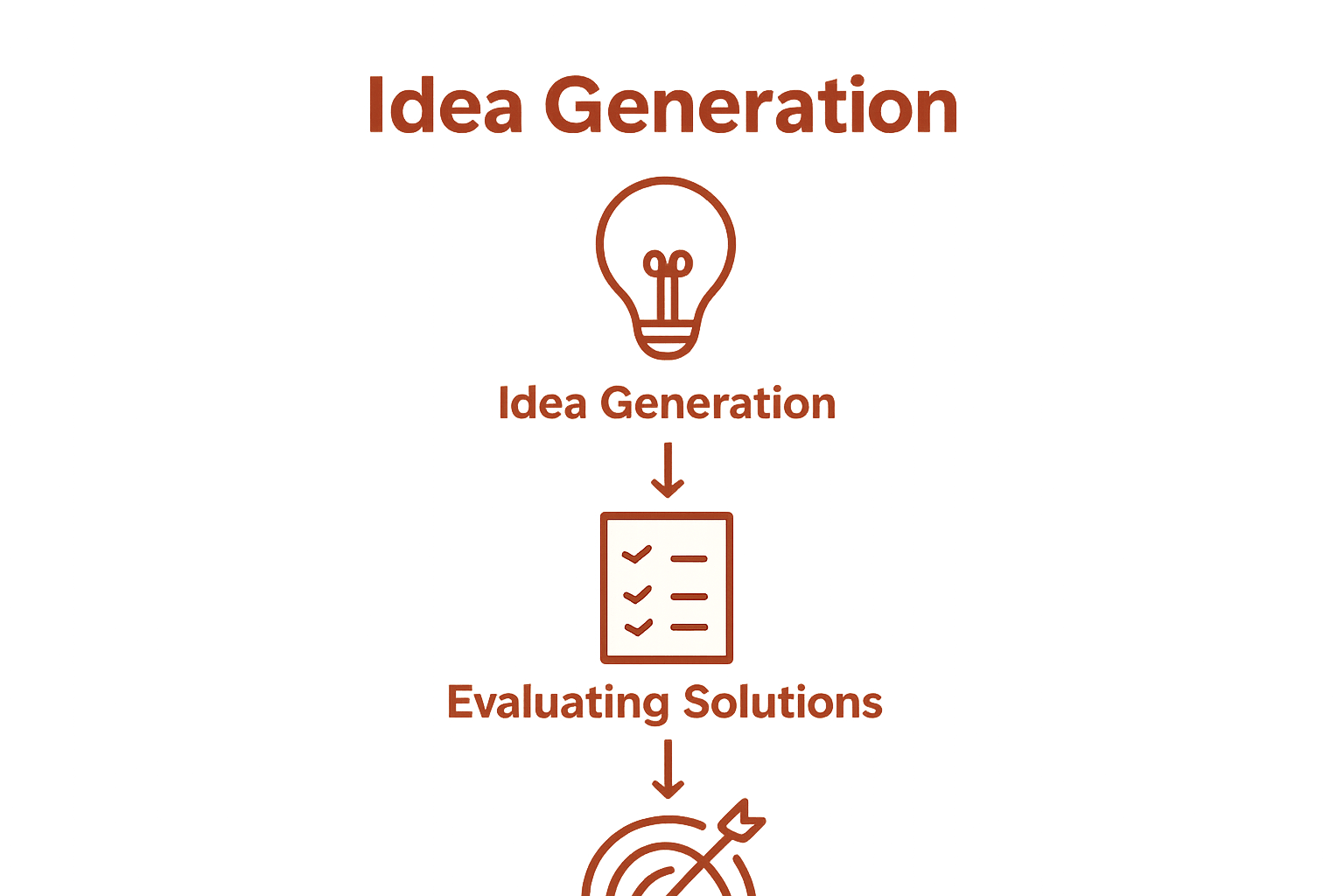
Step 6: Implement and Review the Chosen Solution
Implementation transforms theoretical solutions into tangible results. This critical stage demands precision, commitment, and ongoing adaptability. Successful implementation is not a single event but a dynamic process of careful execution and continuous monitoring.
Begin by creating a detailed implementation roadmap that breaks down the solution into specific, actionable steps. Assign clear responsibilities to team members, establishing precise timelines and measurable milestones. Each team member should understand their specific role, expected contributions, and how their work connects to the broader solution. Develop a communication plan that ensures transparent, regular updates and provides mechanisms for addressing unexpected challenges quickly.
Research from the National Institutes of Health emphasizes the importance of structured implementation approaches. Build flexibility into your plan, recognizing that real world execution often requires subtle adjustments. Establish checkpoints where the team can collectively assess progress, identify potential obstacles, and make data driven refinements. These review sessions are not about assigning blame but about collaborative problem solving and continuous improvement.
Create a robust tracking system that captures both quantitative metrics and qualitative feedback. This might involve digital dashboards, regular team meetings, or detailed progress reports. Monitor not just the outcomes, but the process itself. Are team members encountering unexpected barriers? Do the initial assumptions still hold true? Encourage an environment where team members feel comfortable sharing challenges and suggesting modifications.
To verify successful implementation, assess three key indicators. First, measure whether the solution is achieving the intended outcomes defined in your original problem statement. Second, evaluate team engagement and collective understanding of the implementation process. Third, identify any unexpected positive or negative consequences that emerged during execution. A successful implementation goes beyond simply completing tasks it represents a team’s ability to translate collaborative thinking into meaningful, measurable change.
Below is an overview table summarizing each main step in the team problem solving process, along with its core focus and the key outcome it aims to achieve.
| Step | Main Focus | Key Outcome |
|---|---|---|
| 1. Define the Problem | Clear problem definition | Actionable, well-understood problem statement |
| 2. Assemble Team | Strategic team selection | Diverse, collaborative team with relevant skills |
| 3. Gather & Analyze Data | Systematic data collection & analysis | Comprehensive understanding of root causes |
| 4. Brainstorm Solutions | Inclusive ideation | Wide range of potential solutions |
| 5. Evaluate & Select | Objective assessment | Best-fit solution identified |
| 6. Implement & Review | Execution & measurement | Implemented solution with team engagement |
Turn Your Team’s Insights Into Real Change at The Nest
Your team has mastered the steps of effective problem solving, from defining challenges to implementing solutions. But breaking through old habits and building genuine collaboration can feel impossible in the day-to-day office environment. Many teams get stuck in endless meetings, experience low morale, or struggle to turn clear strategies into action. The Nest was created specifically for teams like yours who want to go beyond theory and experience true transformation.

Imagine your team stepping away from traditional silos and distractions. At The Nest, you can put your new skills to use with immersive workshops, targeted strategy sessions, and energizing group experiences. Move your problem solving from discussion to innovation in a space designed for deep work, trust, and real connection. Discover how our thoughtfully crafted team retreat experiences can help you break free from old patterns, reignite momentum, and drive change that lasts.
Ready to see your team’s potential come alive? Explore The Nest today and start planning your next breakthrough.
Frequently Asked Questions
What is the first step in effective team problem solving?
Clear problem definition is the first step. This involves creating a comprehensive problem statement that captures the core issue in specific, measurable terms and encourages collaboration among team members.
How can I ensure I have the right team for problem solving?
Select team members with diverse skill sets and complementary strengths. Look for individuals who demonstrate curiosity, adaptability, and strong communication skills to foster effective collaboration.
What role does data gathering play in problem solving?
Data gathering helps to create a comprehensive understanding of the problem. It involves collecting relevant internal and external information to inform decision-making and drive effective solutions.
What techniques can enhance brainstorming sessions?
Utilize techniques like mind mapping, reverse brainstorming, and structured capturing of ideas to encourage diverse thinking and promote an inclusive environment during brainstorming sessions.
Recommended
- How to Boost Team Morale: 5 Psychology-Backed Strategies – Hoop Mentality
- How to Manage Team Dynamics for Optimal Collaboration – Blog